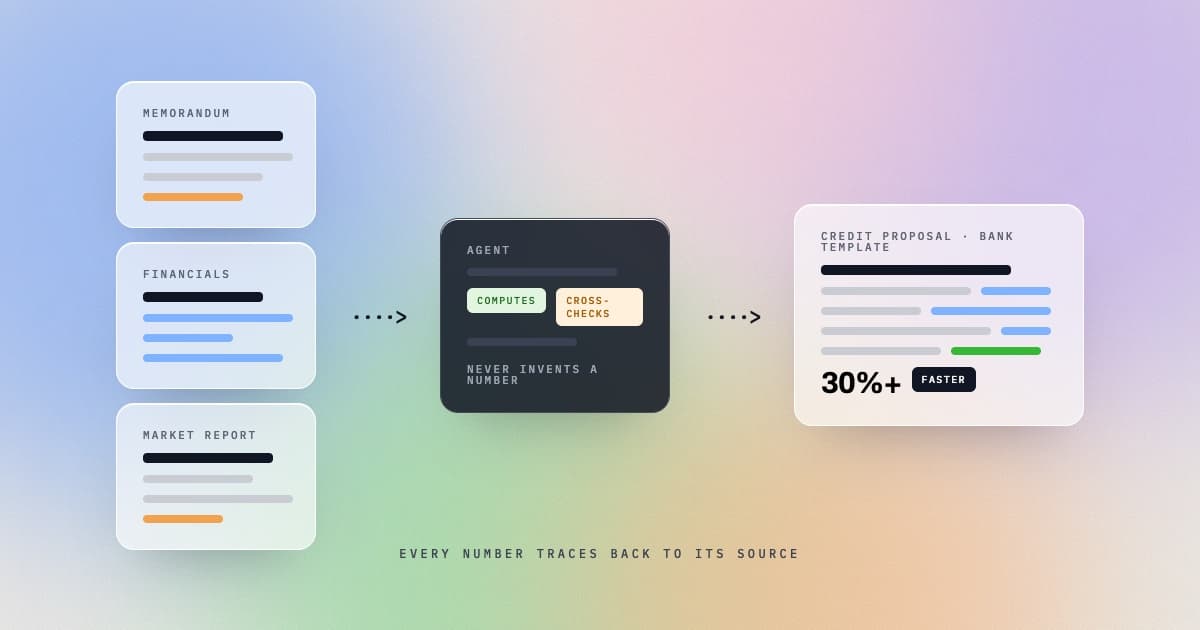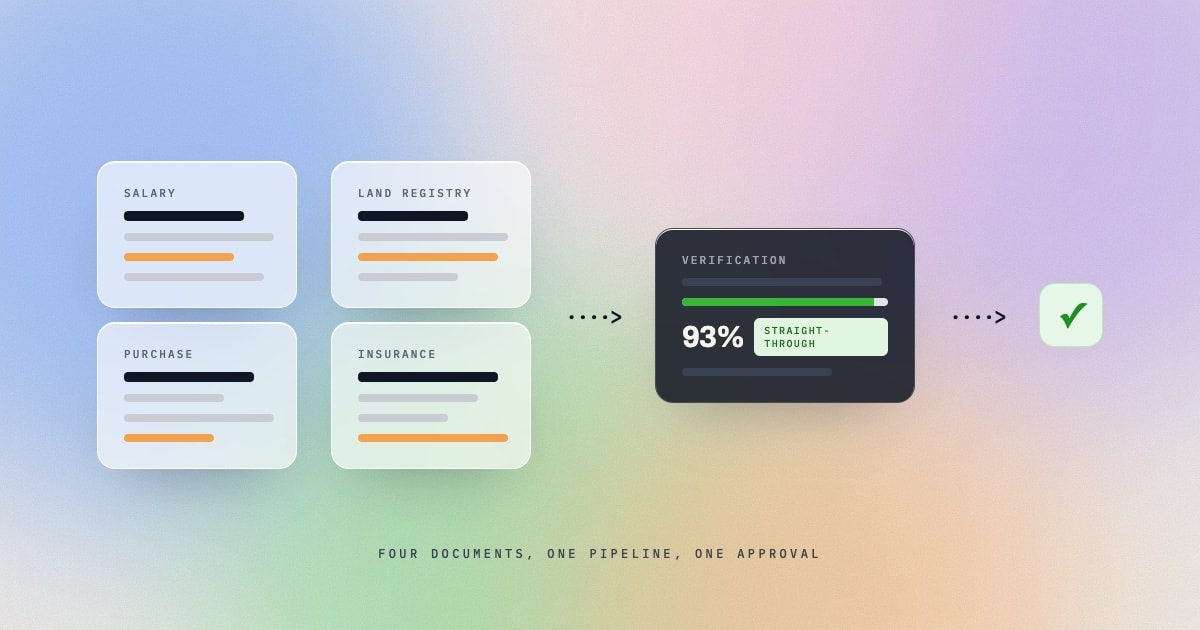
A tier-1 retail bank (>$2B annual revenue) needed to increase mortgage processing throughput without expanding headcount.
The bottleneck wasn’t demand — it was verification. Back-office teams were manually parsing bank statements, rekeying purchase agreements, checking land registries, and validating insurance documents. Inputs were unstructured and inconsistent: low-quality scans, dozens of statement formats, dense legal language. Every action required a traceable audit trail.
We deployed the EigenPal platform inside the bank’s cloud and automated four verification workflows end-to-end — converting a manual, document-heavy process into a structured, auditable pipeline.
Their workflows
1. Salary verification from bank statements
Mortgage specialists were reviewing customer bank statements line by line to verify recurring salary inflows, match employer names, and cross-check against declared income. Statements came from dozens of different banks with different formats.
We extract all transactions, identify probable salary payments, match employer names, and output a structured verification result directly into the bank's internal forms.
Part 1: Salary verification from bank statements pipeline
Part 2: Salary verification from bank statements pipeline
2. Purchase agreement extraction and contract pre-fill
Staff were reading house purchase agreements and manually retyping buyer/seller details, property identifiers, purchase price, addresses, and dates into the mortgage contract prep flow. Slow, and prone to rekeying errors.
We extract the relevant fields from the agreement and map them into the bank's required schema, producing a pre-filled contract package ready for review.
Where humans stay in the loop. Both workflows (1) and (2) are maker-checker processes. We automated the maker role. When the system hits edge cases or ambiguities, it flags the exact reason for human review - e.g., "employer name mismatch on page 3" or "low-confidence scan on purchase price." The reviewer doesn't re-read the whole document; they check the flagged issues.
Result: 80% process speedup, ~5 FTEs saved. Human validation preserved where it matters.
3. County land records verification
Following closing, the lender must verify that its mortgage or deed of trust has been properly recorded in the county land records and that the recorded data matches the expected property, borrower, and lien details. This step is foundational to perfecting the lender’s security interest. 
This workflow is highly automatable because the expected outcome is already known. EigenPal retrieves the public filing, extracts the recorded fields, and validates them against the loan file and business rules. Clean matches are processed end-to-end with no human touch and only exceptions are escalated for review, with the discrepancy clearly identified.
Result: 93% straight-through automation rate. Manual review required in 7% of cases.
How it works
You can't just throw a long prompt at an LLM and hope it handles messy real-world documents reliably. We built a multi-stage pipeline designed around predictability, auditability, and continuous improvement.
Scoped LLM blocks. Instead of one monolithic prompt, we constrain each LLM call to a specific, narrow task. This makes the pipeline more robust and every decision traceable. When something goes wrong, we know exactly where.
Deterministic logic where possible. We use scripting and rule-based validation wherever the logic is well-defined. LLMs and OCR handle the unstructured parts. No point using a model where a regex works.
Eval-first development. Every change to prompts or extraction logic runs against evaluation datasets before deployment. We don't ship changes that regress accuracy.
Automated feedback capture. When an operator corrects the system on an edge case, that correction feeds back into our evaluation and training data. The system gets sharper over time as volume increases.
Because the pipeline is modular at the block level, we can swap underlying models as better ones ship - during this project we upgraded the core extraction model mid-deployment and picked up a 2-point accuracy gain with no prompt changes.
Results
Across all four workflows, the pipeline achieved 97% average accuracy on the bank's validation datasets.
- 80% process speedup on human-assisted workflows
- ~15 FTEs saved in mortgage back-office operations
- 93% straight-through automation on deterministic checks
- 97% accuracy across OCR, LLM, and deterministic pipeline stages