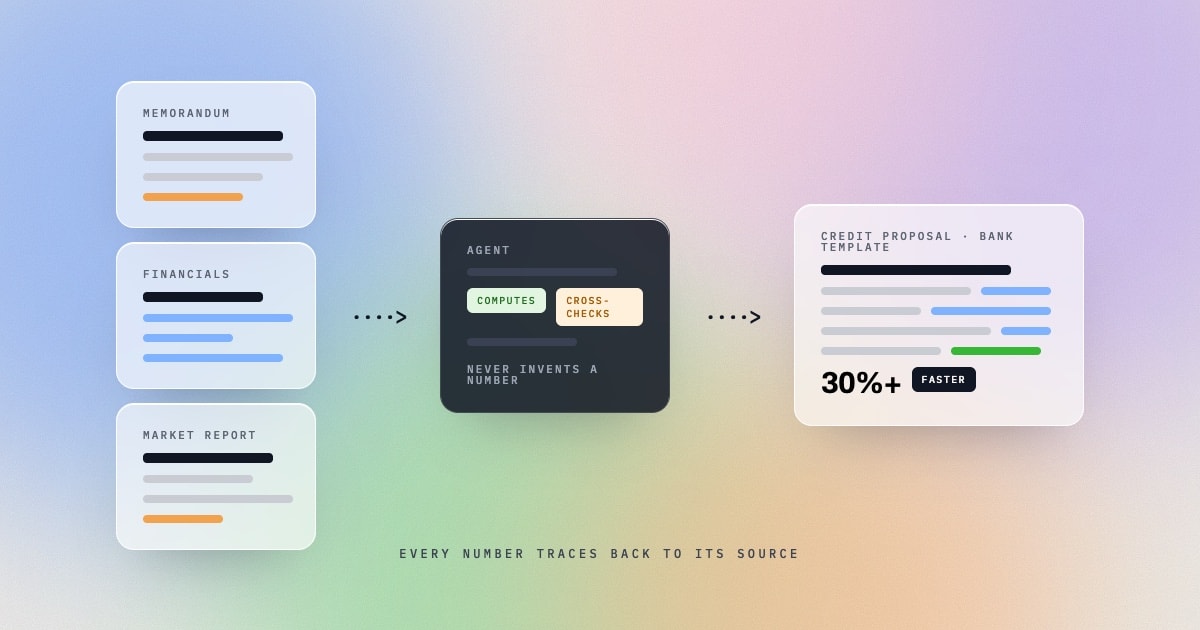
For a multi-million-euro corporate facility, the banker assembles a deal pack: a project memorandum with the sponsor's narrative, track record and the terms sought; a financial information pack with the P&L, balance sheet, debt schedule and sensitivities; and a market research report with pricing comparables and submarket indicators.
Then the banker writes the credit proposal. Most of that writing is transcription and arithmetic: pulling figures out of three documents, computing the margins, leverage and trends the template asks for, and filling in the bank's format. The judgement comes at the end, if there is time left for it.
We built a workflow that does the transcription and the arithmetic, held to the bank's standards, and hands the banker a complete draft.
An agentic workflow, not a fixed pipeline
Every deal is different. The agent decides which template sections apply, what is missing from the pack and which cross-checks to run, rather than following one fixed sequence.
Reads the deal pack in parallel. The memorandum, the market research and the bank's own template rules are read together, so the agent knows what the proposal needs before it touches a number.
Reads the financials. The workbook is parsed into P&L, balance sheet, debt schedule and cash flows. If the file is malformed, the workflow falls back to cell-by-cell extraction rather than failing.
Synthesises the data set. Every derived figure is computed by the workflow under strict formatting rules: margins, leverage, trend direction.
Fills, then self-checks. The bank's Word template is populated through the DOCX Editor built into EigenPal Studio, so the draft lands in the format the credit committee already uses. The agent then scans its own output for any field left unfilled and fixes it before moving on.
The discipline of a credit officer
Three rules shaped the design, and the evaluation set enforces them.
- Never invent a number. Only figures present in the source documents, or computed from them, appear in the draft.
- Compute what is not stated. Margins, leverage ratios and trend direction are derived and shown with their inputs.
- Check the draft before delivery. An incomplete proposal never reaches the banker.
Results
- More than 30% reduction in credit proposal creation time
- Proven on real-estate development financing with three input documents
- Every number in the proposal traces back to its source document
- The banker's time moves from transcription to the case itself