A private equity group runs accounts payable for a portfolio of companies. Every entity receives supplier invoices its own way: PDFs attached to emails, invoices typed into the email body, scans, and links to supplier portals where the invoice has to be fetched. Every entity also has its own SAP setup, its own tax codes and its own purchase-order conventions.
The work was the same everywhere. Someone opened the email, found the invoice, read the header and the line items, matched it to a purchase order, chose the tax code and typed it all into SAP. Each new acquisition added another inbox to the pile.
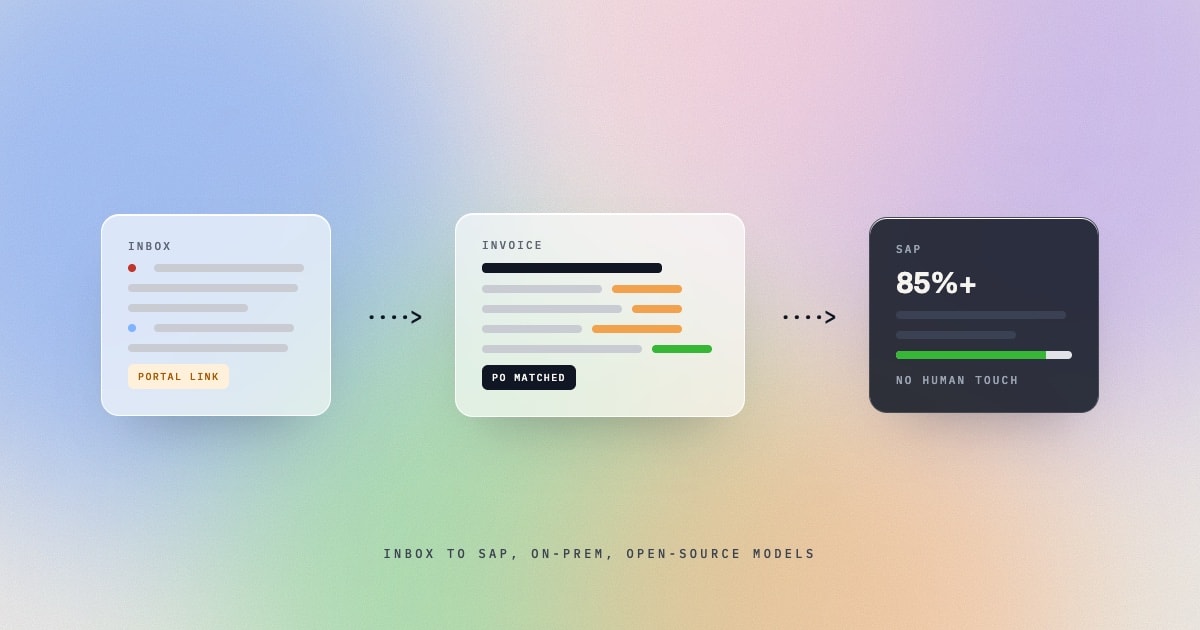
We deployed EigenPal on the group's own infrastructure, on open-source models, and automated the whole path from inbox to SAP.
What the workflow does
Reads any format. PDFs, email bodies, scans and supplier portals all land in the same workflow. When the invoice is not attached, the workflow follows the portal link and downloads it.
Extracts everything SAP needs. Vendor, invoice header, line items, amounts and tax, then matches the invoice to its purchase order.
Posts to SAP through the API. High-confidence invoices go straight through. Low-confidence cases, and every tax-code decision at first, are routed to a person.
Rejects what should not be paid. The workflow screens for phishing and spam invoices before anything reaches SAP.
Built from real examples, per entity
Nobody wrote a specification. Each entity handed over roughly 100 real invoices with the values that had been entered into SAP for them, and the workflow was replicated from those.
Because every entity is different, every entity gets its own versioned workflow with its own evaluation set. A change for one company is tested against that company's invoices before it ships, and does not touch the others. That is what makes onboarding the next acquisition a matter of days rather than the months an RPA project would take.
Why open-source models on-prem
The group did not want supplier and payment data leaving its environment. The whole stack runs on the group's own hardware: vision-language models handle OCR for scans, language models handle the business logic, and nothing is sent to an external API.
Results
- 85%+ of invoices processed and posted to SAP without human intervention
- Roughly 10x faster to onboard a new portfolio company than with traditional RPA
- Each entity replicated from about 100 real invoices, not a written spec
- Tax codes kept human-in-the-loop until accuracy held, then sampled